Showing posts with label Aurora. Show all posts

Saturday, August 30, 2014

A SPECIAL DIAMOND EXHIBIT AT NHM Los Angeles, running through January 6, 2015

The reunion of exceptional diamonds

Beginning September 13, 2014 and until January 6, 2015, we will have a special reunion of diamonds at NHM: The Blue Moon Diamond will meet the Butterfly of Peace diamond collection. The collection of 240 natural fancy-colored diamonds that make the spectacular Aurora Butterfly of Peace is already worldwide renown and well traveled: it had been on special exhibits at the Smithsonian Institution and at the Houston Museum of Science, just to cite only a few of the prestigious places it has seen. The Butterfly of Peace will have a new companion beginning September 13: The Blue Moon Diamond, which was recently discovered in South Africa. Now faceted from the 29.6-carat rough, the 12-ct stone will also be displayed in the Gem Vault of the Natural History Museum of Los Angeles County.

The renown Aurora Butterfly of Peace: 240 natural fancy-colored diamonds. All known colors of diamonds are represented in this unique and exceptional collection totaling 167 carats of beauty. The collection is not only a delight for the public but also for the scientists to study. The variety of colors makes it the best tool to analyze the color in diamonds. On loan from Aurora Gems. Photo by Robert Weldon. Copyright: GIA.

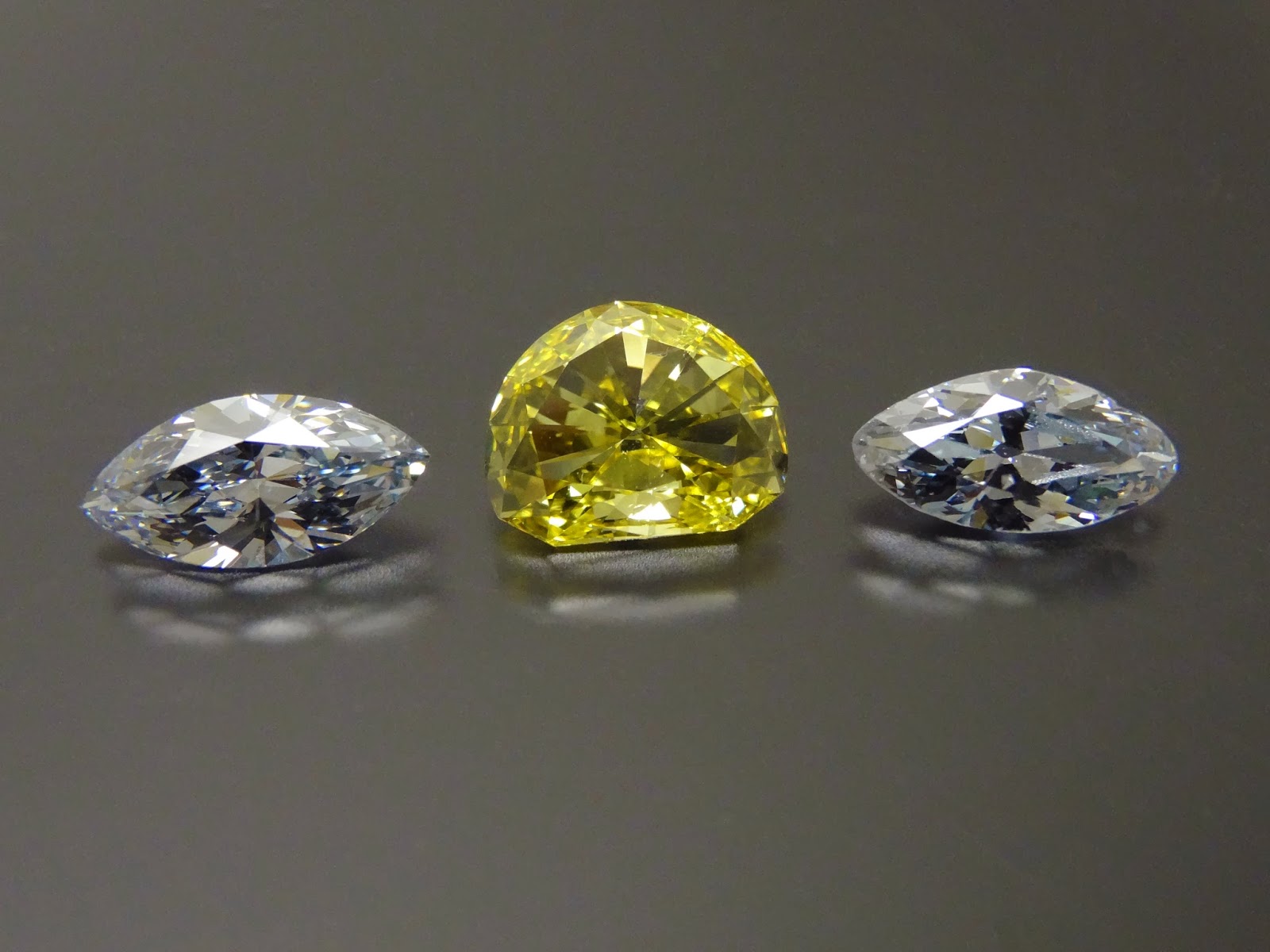
The 12-carat Fancy Vivid Blue Moon Diamond. Recently discovered in South Africa, this diamond shows the most exquisite of the blue colors. Such as the Butterfly of Peace diamond collection, the Hope diamond, or the Wittelsbach-Graff, it was studied at the Smithsonian Institution before coming on exhibit to our museum. On loan from Cora International. Photo by Tino Hammid. Copyright: Cora International.


The Aurora Butterfly of Peace on exhibit at NHM


Add 240 fancy-colored diamonds, the rarest of all the gems. Arrange it carefully in a butterfly shape that took the owner (Aurora Gems) over 10 years to put together. Obtain a delightful art-piece that will be a joy for the public and the connoisseur to look at!

The Aurora Butterfly of Peace on exhibit at NHM. Photo and copyright: K. Stone.

The Aurora Butterfly of Peace as seen on its display case. Photo and copyright: E. Gaillou for NHM.

A different look at the Butterfly of Peace! Photo and copyright: E. Gaillou for NHM.

I would like to quote my colleague George Harlow from the American Museum of Natural History (AMNH): when the Butterfly of Peace was on exhibit at the AMNH, he mentioned that their colored diamond exhibits have “the highest slobber factor of anything in the gem house” with “nose prints and handprints” commonly found on the glass. We would concur with that! Good thing that our display cases are cleaned every morning...

The Blue Moon Diamond: from rough to cut


The 29.6-carat rough stone was unearthed at the Cullinan Mine in South Africa by Petra Diamonds in January 2014. In February, Cora International bought it and began the cutting process in April 2014. The cut stone was finished at the end of June. The photos below show you a few steps of the cutting process from the rough to the cut stone. Before cutting the blue stone, models of it were made and cut. No rough stone is perfect to begin with, and inclusions and impurities have to be avoided during the cutting process so that the cut stone doesn't have any inclusion in it. The design of the stone was so well done that the stone has been graded "Internally Flawless" by GIA.

The rough 29.6-carat Blue Moon Diamond on the cutting wheel. Copyright: Cora International.

The first "window" is open in the diamond. It is from this first facet that the other ones will be built from. Copyright: Cora International.

More facets are polished. Isn't it scary to see such a valuable diamond in such position?! Copyright: Cora International.

Some of the front facets are polished, while the back of the Blue Moon is still rough. Copyright: Cora International.

The Blue Moon diamond on the cutting wheel. Copyright: Cora International.

Almost there! But still a few more facets to be cut on the back of the stone. Copyright: Cora International.

On this shot, we already can see the finished shape of the stone. It begins to look like a little brother of the Hope diamond!

The Blue Moon Diamond will be on display in the Gem Vault of the NHM from September 13, 2014 until January 6, 2015, next to the Butterfly of Peace diamond collection. It will most likely be the ONLY public appearance of this diamond, so rush in! Especially that you can see this special reunion of exceptional diamonds with a regular NHM admission.

On view at:
900, Exposition Bvd
Los Angeles, CA 90007
(213)-763-3466

Sunday, December 8, 2013

Aurora Butterfly of Peace: A History of the Collection

The Aurora Butterfly of Peace, on exhibit at the Natural History Museum of Los Angeles County. Photo: Kristjan Stone for NHMLAC.

The Aurora Butterfly of Peace: 240 natural fancy colored diamonds, here viewed at an unusual angle. Photo / Copyright: Eloïse Gaillou.


When New Jersey diamond dealer Alan Bronstein saw his first colored diamond in 1979 he was immediately captivated. He thought the canary yellow diamond shone like the sun. Surprisingly to him, such beautiful stones were something of an underground commodity. Back in the 1970s and 80s, colored diamonds were not commercially popular and 99% of dealers had no interest in them.  Bronstein began to collect these diamonds, buying one stone at time from the few other dealers who loved them. Diamond dealers tend to be secretive, hoarding knowledge, protecting their sources. A few dealers were willing to sell the colored diamonds and to teach him more about the stones and their origins. These dealers often became his close friends and mentors and together they could share their enthusiasm for the elusive stones.

Bronstein’s collection grew gradually, with some diamonds sold and replaced by better examples. By 1989 he had amassed a fine assortment. He arranged 60 stones into the outline of a butterfly, determined to fill it in. Over the next twelve years he did just that, eventually reaching the current arrangement of 240 diamonds. The Butterfly is a spectacular work of art in harmony with nature. The stones are perfectly arranged to show a wide spectrum of color that natural diamonds can have. The selection process of placing diamonds of similar size and color on each wing also creates an amazing display under ultraviolet light. Stones of the same color may also show a similar color in fluorescence. When seen in UV light, the butterfly becomes a rainbow of glowing diamonds.

An early version of the Aurora Butterfly (scanned image). Photo Courtesy of Alan Bronstein.

The Butterfly grows as more diamonds are added (scanned image). Photo courtesy of Alan Bronstein.

For years Mr. Bronstein showed the collection only to friends and colleagues who would most appreciate the rarity of the diamonds (as well as the time and effort that went in to obtaining them). Eventually he showed the Butterfly to Nicola Bulgari, a man of discerning tastes who is not easily impressed.  When Bulgari saw the Butterfly he exclaimed “This, I have never seen before!”. That moment convinced Mr. Bronstein that he should show the collection to a larger audience. The first public showing of the Butterfly was at the Houston Museum of Natural Science. At that time it contained only 162 diamonds. When it had reached its current size, Mr. Bronstein approached the Curator of Minerals at the Smithsonian, Dr. Jeffrey Post. Dr. Post visited Mr. Bronstein’s New York office intending to stay for ten minutes. He left four hours later with a promise to have the Butterfly displayed in Washington D.C.

 
Left to right: Dr. Eloïse Gaillou, Assoc. Curator of Mineral Sciences with Alan Bronstein, Curator of the Aurora Collection and Dr. Jeffrey Post, Curator, Smithsonian National Museum of Natural History. Photo by Kristjan Stone for NHMLAC.

Associate Curator Eloïse Gaillou welcoming guests at the unveiling of the Aurora Butterfly of Peace exhibit. Photo: Kristjan Stone for NHMLAC.

On December 4th, 2013 the Butterfly arrived at the Natural History Museum of Los Angeles County. Mr. Bronstein believes the Butterfly belongs in museums dedicated to science and education. He stresses his admiration and support for institutions whose mission is to inspire a love of knowledge and concern for our natural world. Though the Butterfly is a stunning artistic piece, it is more importantly a part of the Earth, created by nature. He believes its greatest significance lies in its ability to impart a sense of wonder of the universe. There are few, if any, opportunities for most people to see such a variety of colored diamonds together in one exhibit and it can make a lasting impression. He has seen children (even very young ones) get so excited at the sight of the diamonds and ask so many questions about them. The beauty of the Butterfly is universally appreciated and draws people in, they cannot help but wonder where the diamonds come from and what makes them so beautiful.  

Mr. Alan Bronstein's speech at the unveiling of the Aurora Butterfly of Peace exhibit. Photo: Kristjan Stone for NHMLAC.


We are so happy that the Butterfly has now alit in the Hixon Gem Vault at the Natural History Museum of Los Angeles County.
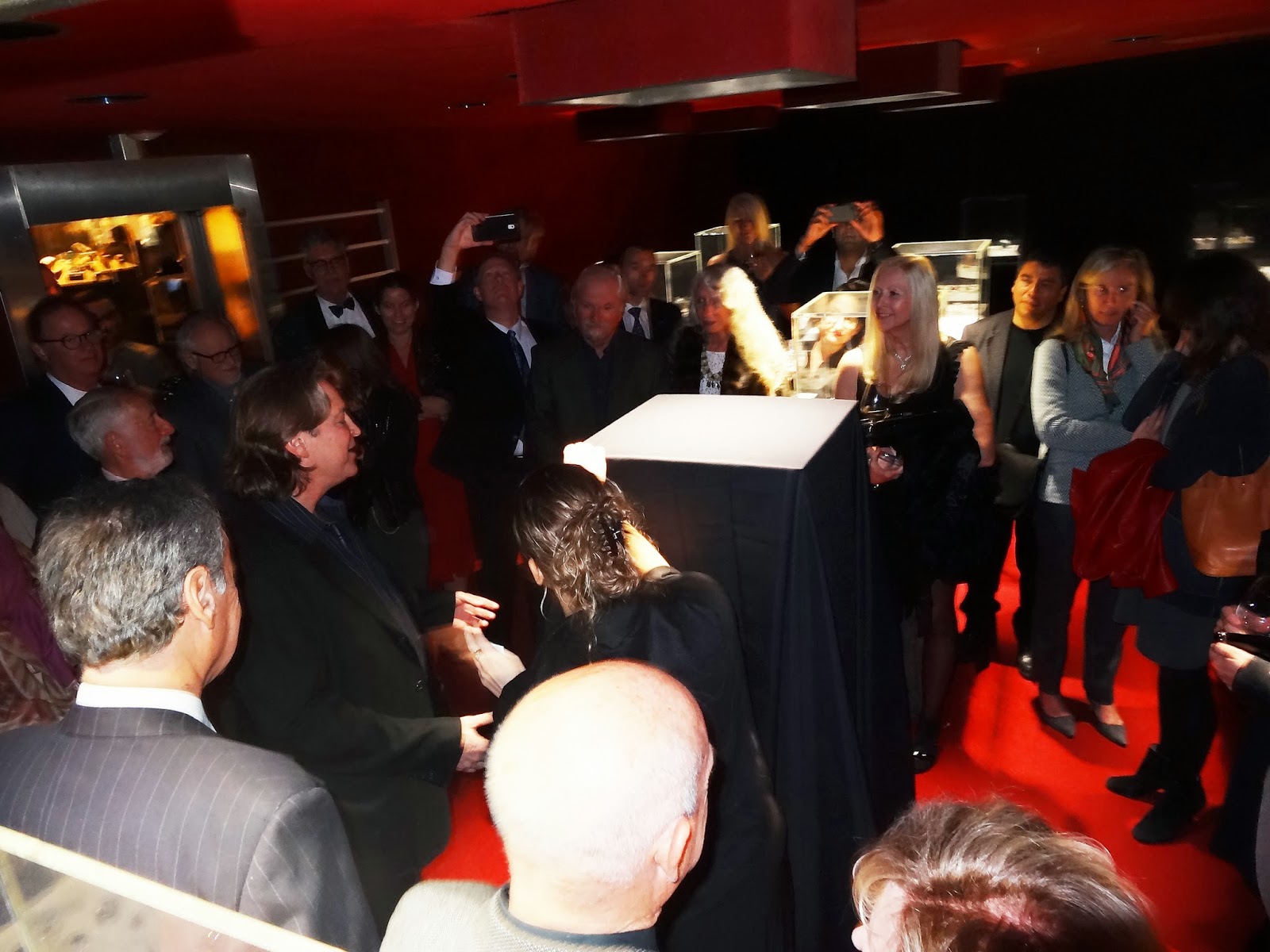
Gathering around the display case in the Gem Vault for the unveiling. Photo: Kristjan Stone for NHMLAC.

Mr. Alan Bronstein unveiling the Aurora Butterfly of Peace in the Gem Vault. Photos: Kristjan Stone for NHMLAC.

Left to right: Annette Bronstein, Eloïse Gaillou and Alan Bronstein.

Young admirers. Photo: Kristjan Stone for NHMLAC.


Let's end with some close-up pictures of the Butterfly of Peace, as never seen before. All  pictures below are by Eloïse Gaillou.

Wednesday, November 27, 2013

The Aurora Butterfly of Peace: bringing it to the NHMLAC

The Aurora Butterfly of Peace: an art piece composed of 240 natural fancy colored diamonds. Photo: Robert Weldon. Copyright: Alan Bronstein.


COLORED DIAMONDS


By now, I think that most of you know my passion for colored diamonds. Yes, they are pretty and some are extremely expensive. But my interest is mainly in their scientific significance. It is because they contain fortunate imperfections that they have color. These imperfections can tell us more about the environment in which diamonds grow. In particular, I study the pinks and the blues: 

- pink (to purple and red) diamonds have undergone some intense plastic deformation while still in the Earth's mantle (150km or below). To accommodate extreme forces in the deep Earth, diamond might not break, but instead re-arrange its atomic structure, creating slip planes (or even twinning, in the case of pink diamonds). This can only occur under the high pressure and high temperature regime of the Earth's mantle. But what is the exact imperfection that gives the pink color and why is it so rare to find pink diamonds?

- blue diamonds contain boron impurities, which give them their characteristic blue color (such as in the Hope diamond). But what is boron doing so deep inside the Earth? Boron is a volatile element and is mostly found at the surface of the Earth, not really expected to be found 150 km deep or below. How did get there?

These are only a few questions that I'm trying to answer.

Wing shot of the Butterfly of Peace. Photo / Copyright: Eloïse Gaillou.

THE QUEST FOR SAMPLES


During my quest for samples when I was a post doc at the Smithsonian Institution, Mr. Alan Bronstein crossed my path. As you can imagine, it's not easy to find such rare and expensive diamonds (here, I'm talking about over $2M per carat for the best pink and blue diamonds!). Even the Smithsonian does not have THAT many blues or pinks. And hey, sometimes, you can't do all the experiments you want / need on the Hope or on the Blue Heart diamonds... Can you imagine putting a multi-million dollar into the crusher?

Mr. Alan Bronstein, a New York based diamond dealer, owner of the company Aurora Gems came into play when curator Jeffrey Post of the Smithsonian asked him to help us in our scientific investigation, back in 2010. Mr. Bronstein told us that he will try to help us. A few weeks later, he had 70 blue diamonds for us to analyze! Incredible! Thanks to this new set of data, we were able to complete our study, and publish an article on blue diamonds.

Following up on our interests on colored diamonds, Mr. Bronstein suggested that I should get a chance to study one of his collections of fancy colored diamonds. He sent the Aurora Butterfly of Peace to the Smithsonian in August 2011, so I can "play" with the diamonds in the collection. I knew already that I got the position of Associate Curator at the NHMLAC and had a lot of research projects to wrap up both at the Carnegie Institution for Science and at the Smithsonian. But how often would I have the chance to look at 240 fancy colored diamonds?
So, here I was, looking at every single pink and blue diamond in the collection (I had to make a choice of what I needed to study). My advisors Jim Butler and Jeff Post helped me collecting all the data (infrared spectrometry and phosphorescence, mostly).

When I left the Smithsonian, at the end of 2011, I knew that I needed more time to work on the Butterfly. I was still not completely done with the pinks, didn't study the violet to grey from Argyle, and didn't get the chance to have a look at the orange diamonds, which are the least studed of all... and are now "hot" in the market place ($35.5M for a 14.82-ct fancy vivid orange diamond -the largest known-).


BRINGING THE BUTTERFLY OF PEACE TO LA


Still in regular contact with Mr. Bronstein after I left the Smithsonian, we agreed that the Butterfly should come and visit LA, after its stop at the Boston Fine Art Museum. After getting the agreement of the executives of the NHMLAC, and getting all the paperwork, "voilà"! The Butterfly of Peace is in the hands of the Mineral Science team! It will be on exhibit from Dec. 5th 2013 until June 1st 2014. And... I get the chance to look at the diamonds I didn't have the time to look at the last time I had the art piece in my hands.

When we received the Butterfly and I opened the box containing the diamonds, my heart pumped a few stronger, faster beats! Yes, what an art-piece! Honestly, no photo can do it justice. You know how great a single diamond looks like. Now, imagine 240 of them, all of different colors. AND arranged in a butterfly shape. It is just extraordinary!

A moving moment when I received the Butterfly of Peace. Opening it for the first time after 2 years was a great feeling.Photo / Copyright: Eloïse Gaillou.
Alright, here it is. Wow....... now, let's check if all the diamonds are here! Photo / Copyright: Eloïse Gaillou.

Mr. Alan Bronstein and deceased Harry Rodman put the art-piece together, one stone at a time, dedicating it to "the dissemination of peace and harmony among all men, religions and races". When you look at the Butterfly, peace definitely surrounds you. Well, at least it works on me, and I can't ever get tired of staring at it. Alright, I have to admit, it's even better when you get the chance to play with the diamonds!

Talking about playing, here are a few shots I got of some of the diamonds.
"The Stars of the Night". 
Just love this association of colors. The orange heart-shape diamond (1.10 ct) comes from the body of the butterfly, the yellows (1.11 & 1.02 ct) and pinks from the wings. Photo / Copyright: Eloïse Gaillou.

Pink diamonds from the Butterfly of Peace collection. From left to right: 0.66, 0.48 and 0.49 carats. Photo / Copyright: Eloïse Gaillou.

Opalescent diamonds from the Butterfly of Peace collection. From left to right: 1.94, 1.95 and 1.58 carats. Photo / Copyright: Eloïse Gaillou.
 
Compare a 1.62-carat pink (left) with a 1.21-carat bluish-violet diamond, most likely coming from the Argyle mine in Australia. Photo / Copyright: Eloïse Gaillou.

Colorful diamonds from the Butterfly of Peace: green (1.12 ct), pink (0.15 ct) and orangy-yellow (1.31 ct). Photo / Copyright: Eloïse Gaillou.

"You are stealing my heart". 
All extracted from the Butterfly of Peace, of course! Blue diamonds: 0.53 & 0.56 ct; orange: 1.10ct. Photo / Copyright: Eloïse Gaillou.

 By now, you understood that I like the orange heart-shaped diamond! Photo / Copyright: Eloïse Gaillou.

 And I love the white diamonds as well (1.92 ct). Here, associated with this stunning yellow diamond (1.19 ct). Photo / Copyright: Eloïse Gaillou.

Great combination of blue (0.68 & 0.58 ct) and yellow (1.05 ct) diamonds, from the wing of the Butterfly of Peace. Photo / Copyright: Eloïse Gaillou.


FLUORESCENCE


The Aurora Butterfly of Peace, under exposure to UV. A lot of the diamonds fluoresce. Notice that the owner tried to match not only the color, but also the fluorescence on each side of the butterfly's wing. Photo: Robert Weldon. Copyright: Alan Bronstein.

I already explained the cause of color for diamonds in previous blog posts. But I never did for fluorescence. Here is a little blurb on the matter.

It is known that about thirty-seven percent of near-colorless diamonds fluorescence; out of those, ninety-seven percent display a blue fluorescence. The percentage of fluorescing colored diamonds have not been reported yet, but a comprehensive study on fluorescence of colored diamonds can be found in Eaton-Magaña et al. (2007). A blue fluorescence is also commonly seen in some colored diamonds, such as pink, white and Cape yellow diamonds. This blue fluorescence for both colorless and colored diamonds is often due to the N3 center (aggregated of 3 nitrogen atoms around a vacancy), very often associated with the so-called Blue-Band. The Blue Band (also named Band A) is possibly related to the presence of dislocations inside the diamond structure. Yellowish-green emission is fairly common among brown and yellow-green diamonds. It is often due to the H3 center (two atoms of nitrogen around a vacancy) and is created during plastic deformation. Diamonds presenting an orange tint often display yellow fluorescence. Blue type IIb diamonds never display fluorescence, but they sometimes show phosphorescence. In this case, most of them glow a faint blue-green for only a few seconds after exposure to UV light (especially short-wave UV). In rare cases (the Hope and the Wittelsbach-Graff diamonds for example), blue diamonds will show a long-lasting (more than a minute) red glow (refer to this blog post for more information on the Hope's phosphorescence). Even if the exact nature of the blue-green and red phosphorescence is not yet completely understood, recent research suggests the involvement of boron interacting with other defects or impurities (creating an acceptor-donor pair recombination).

Look at this fluorescence! Photo / Copyright: Chris Raum.