Showing posts with label Hope diamond. Show all posts

Monday, September 1, 2014

Testing the Blue Moon Diamond at the Smithsonian

The Blue Moon Diamond, a 12-carat Fancy Vivid Blue diamond, on display at NHM. Photo by Tino Hammid for Cora International.

Beginning September 13, 2014, we will have a very special host in the Gem Vault of our Natural History Museum of Los Angeles County: The Blue Moon Diamond will be on display until January 6, 2015. The 29.6 ct rough diamond was found back in January 2014 at the Cullinan Mine in South Africa. Cora International purchased it in February and had it cut in a spectacular 12 ct cushion. The faceting of the stone took place from April to the end of June in New York.

First of all, I wanted to emphasize our interest to have such a stone at our museum. Of course, there is the exhibit point of view. What a great opportunity for our public to be able to see a big blue diamond. Yes, 12.03 ct (2.4 grams) is impressive for a blue diamond. They are much, MUCH rarer than colorless diamonds (called "white diamonds" in the market). They are probably some of the rarest of all the gems. This diamond has been graded by the Gemological Institute of America (GIA) Fancy Vivid Blue diamond, with an IF (internally flawless) quality. The cut is perfect. All of these qualities make it a gem as rare as "once in a blue moon", phrase from which its name comes from.

Now, in the scientific point of view, this diamond might be even more exceptional! I have been studying blue diamonds for over 5 years now, mostly when I was a post doc at the Smithsonian Institution. I had the chance to study famous stones such as the Hope diamond, the Wittelsbach-Graff or the Blue Heart diamonds for example. All in all, it's over 100 blue diamonds that I have analyzed. But most of them were less than one carat, and only a few were of known origin (a dozen only). And they are so rare that we had to find ways to borrow some diamonds for our study. If a few came from the National Gem & Mineral collection, most came from private parties. Aurora Gems for example loaned to us over 3/4 of the stones studied. We are thankful that Cora International agreed to let us conduct some (non-destructive!) analyses on the diamond, and also supported me to go to the Smithsonian to acquire the necessary data.

Why blue diamonds are so special? As explained in a previous blog post, their color comes from the element boron. First interesting fact: boron is quite rare deep in the Earth, where diamonds form (in the Earth Mantle, some 90 miles below the Earth surface or deeper!). Boron is a light element and is expected to be found mostly at the surface of the Earth, or not far below. So, where does the boron contained in the rare blue diamonds come from? Was it in the Earth Mantle since the formation of the Earth? Or was it pushed deep inside the Earth through plate tectonics, by convection of a subducting oceanic plate?
Also, we know that boron gives the blue color of a diamond. But does the amount of boron directly correlates with the intensity of the blue color? Blue diamonds have the property of phosphorescing (emitting a color after exposure to an ultraviolet light - also called black light-). Most emit a very short bluish phosphorescence, while a few emit a orange-red glow. What physical phenomenon controls that?

In this blog post, I'll show you a few pictures of the Blue Moon diamonds acquired while we were conducting the experiments at the Smithsonian Institution, in the highly secured "Blue Room", in the Mineral Sciences department. But look forward to an article talking about the actual results in the coming months!
The scientists present during the experiments were: Dr. Jeff Post, Curator and Dr. Keal Byrne, postdoc, both from the Smithsonian Institution; Dr. Jim Butler and myself.

The arrival of the Blue Moon Diamond and its unpacking by Jeff Post.

Waiting to discover the stone we long expected to see!

Far from being a professional picture, our first look at Blue Moon Diamond. There were a lot of "wow" in the room when Jeff opened the package.

The Blue Moon Diamond and the phosphorescence equipment on the background. 

The diamond is now in place to be analyzed. The metallic wire is a fiber optic that conducts the ultraviolet (UV) light and receives the light emitted by the stone. 

A close-up of the experiment: we analyzed several spots on the stone to see if the diamond was emitting similar phosphorescence everywhere.

Jim preparing a cover for the experiment!

There is nothing to see anymore: the diamond is fully covered to be in the dark during the experiment.

Keal and I doing the last tests before running the phosphorescence experiments. Photo by Jeff Post.

What is it that we are doing when we run a phosphorescence experiment? As Jeff shows to the film crew, it's similar to exposing the diamond to a UV light for 20 sec, turning the UV light off and looking if the stone emits a light and if so, what color light. However, our eyes are not as sensitive as a spectrometer is, that is why we use this machine on top of the visual examination.

A very surprising result: the Blue Moon Diamond phosphoresces orange-red for about 20 seconds, while most blue diamonds show a short bluish phosphorescence. Only a few other diamonds have such a reddish glow, we will cite the Hope diamond and the Wittelsbach-Graff for which the phosphorescence lasts a minute! Amazing photo by Tino Hammid for Cora International.

The exact reason for the long red versus short bluish glow is not perfectly understood. That is also why we continue acquiring data on more blue diamonds. It might involve the boron defects present in the structure of diamond, interacting with other impurities, defects or charge imbalance. So far, the Blue Moon diamond is the only diamond known coming from South Africa that shows a red glow. The other diamonds of known locality showing the red glow were coming from India (such as the Hope diamond or the Wittelsbach-Graff).

We also conducted some experiments with a Fourier Transform infrared (FTIR) spectrometer. With this machine, we can see the signal of the carbon atoms interacting with each other, as well as the signal of the possible other impurities. Photo by Jim Butler.

Getting some signal through a faceted stone is not the easiest! But we got some good results. Photo by Jeff Post.

Our FTIR analyses confirmed the presence of the element boron as an impurity, which is the source of the color. The Blue Moon Diamond is therefore classified as a Type IIb diamond (no nitrogen impurities visible by FTIR, but boron impurities present). We will be able to quantify the amount of boron thanks to the spectra acquired. Stay tuned!


Finally, we were curious to look at the remaining strain inside the diamond structure. All natural diamonds show some strain features, and the Blue Moon is no exception. The colored striations are the evidence of such a strain. Photo: Eloïse Gaillou, in between cross-polarizers.

Again, they are not professional pictures, but I still wanted to end with a few shots that I took while conducting the experiments at the Smithsonian. You will have to come to NHM Los Angeles and see for yourself to get the true experience of the color and the fire of the Blue Moon! Photo below and above: Eloïse Gaillou.


All photo credit: Eloïse Gaillou, unless otherwise mentioned.


Saturday, August 30, 2014

A SPECIAL DIAMOND EXHIBIT AT NHM Los Angeles, running through January 6, 2015

The reunion of exceptional diamonds

Beginning September 13, 2014 and until January 6, 2015, we will have a special reunion of diamonds at NHM: The Blue Moon Diamond will meet the Butterfly of Peace diamond collection. The collection of 240 natural fancy-colored diamonds that make the spectacular Aurora Butterfly of Peace is already worldwide renown and well traveled: it had been on special exhibits at the Smithsonian Institution and at the Houston Museum of Science, just to cite only a few of the prestigious places it has seen. The Butterfly of Peace will have a new companion beginning September 13: The Blue Moon Diamond, which was recently discovered in South Africa. Now faceted from the 29.6-carat rough, the 12-ct stone will also be displayed in the Gem Vault of the Natural History Museum of Los Angeles County.

The renown Aurora Butterfly of Peace: 240 natural fancy-colored diamonds. All known colors of diamonds are represented in this unique and exceptional collection totaling 167 carats of beauty. The collection is not only a delight for the public but also for the scientists to study. The variety of colors makes it the best tool to analyze the color in diamonds. On loan from Aurora Gems. Photo by Robert Weldon. Copyright: GIA.

The 12-carat Fancy Vivid Blue Moon Diamond. Recently discovered in South Africa, this diamond shows the most exquisite of the blue colors. Such as the Butterfly of Peace diamond collection, the Hope diamond, or the Wittelsbach-Graff, it was studied at the Smithsonian Institution before coming on exhibit to our museum. On loan from Cora International. Photo by Tino Hammid. Copyright: Cora International.


The Aurora Butterfly of Peace on exhibit at NHM


Add 240 fancy-colored diamonds, the rarest of all the gems. Arrange it carefully in a butterfly shape that took the owner (Aurora Gems) over 10 years to put together. Obtain a delightful art-piece that will be a joy for the public and the connoisseur to look at!

The Aurora Butterfly of Peace on exhibit at NHM. Photo and copyright: K. Stone.

The Aurora Butterfly of Peace as seen on its display case. Photo and copyright: E. Gaillou for NHM.

A different look at the Butterfly of Peace! Photo and copyright: E. Gaillou for NHM.

I would like to quote my colleague George Harlow from the American Museum of Natural History (AMNH): when the Butterfly of Peace was on exhibit at the AMNH, he mentioned that their colored diamond exhibits have “the highest slobber factor of anything in the gem house” with “nose prints and handprints” commonly found on the glass. We would concur with that! Good thing that our display cases are cleaned every morning...

The Blue Moon Diamond: from rough to cut


The 29.6-carat rough stone was unearthed at the Cullinan Mine in South Africa by Petra Diamonds in January 2014. In February, Cora International bought it and began the cutting process in April 2014. The cut stone was finished at the end of June. The photos below show you a few steps of the cutting process from the rough to the cut stone. Before cutting the blue stone, models of it were made and cut. No rough stone is perfect to begin with, and inclusions and impurities have to be avoided during the cutting process so that the cut stone doesn't have any inclusion in it. The design of the stone was so well done that the stone has been graded "Internally Flawless" by GIA.

The rough 29.6-carat Blue Moon Diamond on the cutting wheel. Copyright: Cora International.

The first "window" is open in the diamond. It is from this first facet that the other ones will be built from. Copyright: Cora International.

More facets are polished. Isn't it scary to see such a valuable diamond in such position?! Copyright: Cora International.

Some of the front facets are polished, while the back of the Blue Moon is still rough. Copyright: Cora International.

The Blue Moon diamond on the cutting wheel. Copyright: Cora International.

Almost there! But still a few more facets to be cut on the back of the stone. Copyright: Cora International.

On this shot, we already can see the finished shape of the stone. It begins to look like a little brother of the Hope diamond!

The Blue Moon Diamond will be on display in the Gem Vault of the NHM from September 13, 2014 until January 6, 2015, next to the Butterfly of Peace diamond collection. It will most likely be the ONLY public appearance of this diamond, so rush in! Especially that you can see this special reunion of exceptional diamonds with a regular NHM admission.

On view at:
900, Exposition Bvd
Los Angeles, CA 90007
(213)-763-3466

Wednesday, November 27, 2013

The Aurora Butterfly of Peace: bringing it to the NHMLAC

The Aurora Butterfly of Peace: an art piece composed of 240 natural fancy colored diamonds. Photo: Robert Weldon. Copyright: Alan Bronstein.


COLORED DIAMONDS


By now, I think that most of you know my passion for colored diamonds. Yes, they are pretty and some are extremely expensive. But my interest is mainly in their scientific significance. It is because they contain fortunate imperfections that they have color. These imperfections can tell us more about the environment in which diamonds grow. In particular, I study the pinks and the blues: 

- pink (to purple and red) diamonds have undergone some intense plastic deformation while still in the Earth's mantle (150km or below). To accommodate extreme forces in the deep Earth, diamond might not break, but instead re-arrange its atomic structure, creating slip planes (or even twinning, in the case of pink diamonds). This can only occur under the high pressure and high temperature regime of the Earth's mantle. But what is the exact imperfection that gives the pink color and why is it so rare to find pink diamonds?

- blue diamonds contain boron impurities, which give them their characteristic blue color (such as in the Hope diamond). But what is boron doing so deep inside the Earth? Boron is a volatile element and is mostly found at the surface of the Earth, not really expected to be found 150 km deep or below. How did get there?

These are only a few questions that I'm trying to answer.

Wing shot of the Butterfly of Peace. Photo / Copyright: Eloïse Gaillou.

THE QUEST FOR SAMPLES


During my quest for samples when I was a post doc at the Smithsonian Institution, Mr. Alan Bronstein crossed my path. As you can imagine, it's not easy to find such rare and expensive diamonds (here, I'm talking about over $2M per carat for the best pink and blue diamonds!). Even the Smithsonian does not have THAT many blues or pinks. And hey, sometimes, you can't do all the experiments you want / need on the Hope or on the Blue Heart diamonds... Can you imagine putting a multi-million dollar into the crusher?

Mr. Alan Bronstein, a New York based diamond dealer, owner of the company Aurora Gems came into play when curator Jeffrey Post of the Smithsonian asked him to help us in our scientific investigation, back in 2010. Mr. Bronstein told us that he will try to help us. A few weeks later, he had 70 blue diamonds for us to analyze! Incredible! Thanks to this new set of data, we were able to complete our study, and publish an article on blue diamonds.

Following up on our interests on colored diamonds, Mr. Bronstein suggested that I should get a chance to study one of his collections of fancy colored diamonds. He sent the Aurora Butterfly of Peace to the Smithsonian in August 2011, so I can "play" with the diamonds in the collection. I knew already that I got the position of Associate Curator at the NHMLAC and had a lot of research projects to wrap up both at the Carnegie Institution for Science and at the Smithsonian. But how often would I have the chance to look at 240 fancy colored diamonds?
So, here I was, looking at every single pink and blue diamond in the collection (I had to make a choice of what I needed to study). My advisors Jim Butler and Jeff Post helped me collecting all the data (infrared spectrometry and phosphorescence, mostly).

When I left the Smithsonian, at the end of 2011, I knew that I needed more time to work on the Butterfly. I was still not completely done with the pinks, didn't study the violet to grey from Argyle, and didn't get the chance to have a look at the orange diamonds, which are the least studed of all... and are now "hot" in the market place ($35.5M for a 14.82-ct fancy vivid orange diamond -the largest known-).


BRINGING THE BUTTERFLY OF PEACE TO LA


Still in regular contact with Mr. Bronstein after I left the Smithsonian, we agreed that the Butterfly should come and visit LA, after its stop at the Boston Fine Art Museum. After getting the agreement of the executives of the NHMLAC, and getting all the paperwork, "voilà"! The Butterfly of Peace is in the hands of the Mineral Science team! It will be on exhibit from Dec. 5th 2013 until June 1st 2014. And... I get the chance to look at the diamonds I didn't have the time to look at the last time I had the art piece in my hands.

When we received the Butterfly and I opened the box containing the diamonds, my heart pumped a few stronger, faster beats! Yes, what an art-piece! Honestly, no photo can do it justice. You know how great a single diamond looks like. Now, imagine 240 of them, all of different colors. AND arranged in a butterfly shape. It is just extraordinary!

A moving moment when I received the Butterfly of Peace. Opening it for the first time after 2 years was a great feeling.Photo / Copyright: Eloïse Gaillou.
Alright, here it is. Wow....... now, let's check if all the diamonds are here! Photo / Copyright: Eloïse Gaillou.

Mr. Alan Bronstein and deceased Harry Rodman put the art-piece together, one stone at a time, dedicating it to "the dissemination of peace and harmony among all men, religions and races". When you look at the Butterfly, peace definitely surrounds you. Well, at least it works on me, and I can't ever get tired of staring at it. Alright, I have to admit, it's even better when you get the chance to play with the diamonds!

Talking about playing, here are a few shots I got of some of the diamonds.
"The Stars of the Night". 
Just love this association of colors. The orange heart-shape diamond (1.10 ct) comes from the body of the butterfly, the yellows (1.11 & 1.02 ct) and pinks from the wings. Photo / Copyright: Eloïse Gaillou.

Pink diamonds from the Butterfly of Peace collection. From left to right: 0.66, 0.48 and 0.49 carats. Photo / Copyright: Eloïse Gaillou.

Opalescent diamonds from the Butterfly of Peace collection. From left to right: 1.94, 1.95 and 1.58 carats. Photo / Copyright: Eloïse Gaillou.
 
Compare a 1.62-carat pink (left) with a 1.21-carat bluish-violet diamond, most likely coming from the Argyle mine in Australia. Photo / Copyright: Eloïse Gaillou.

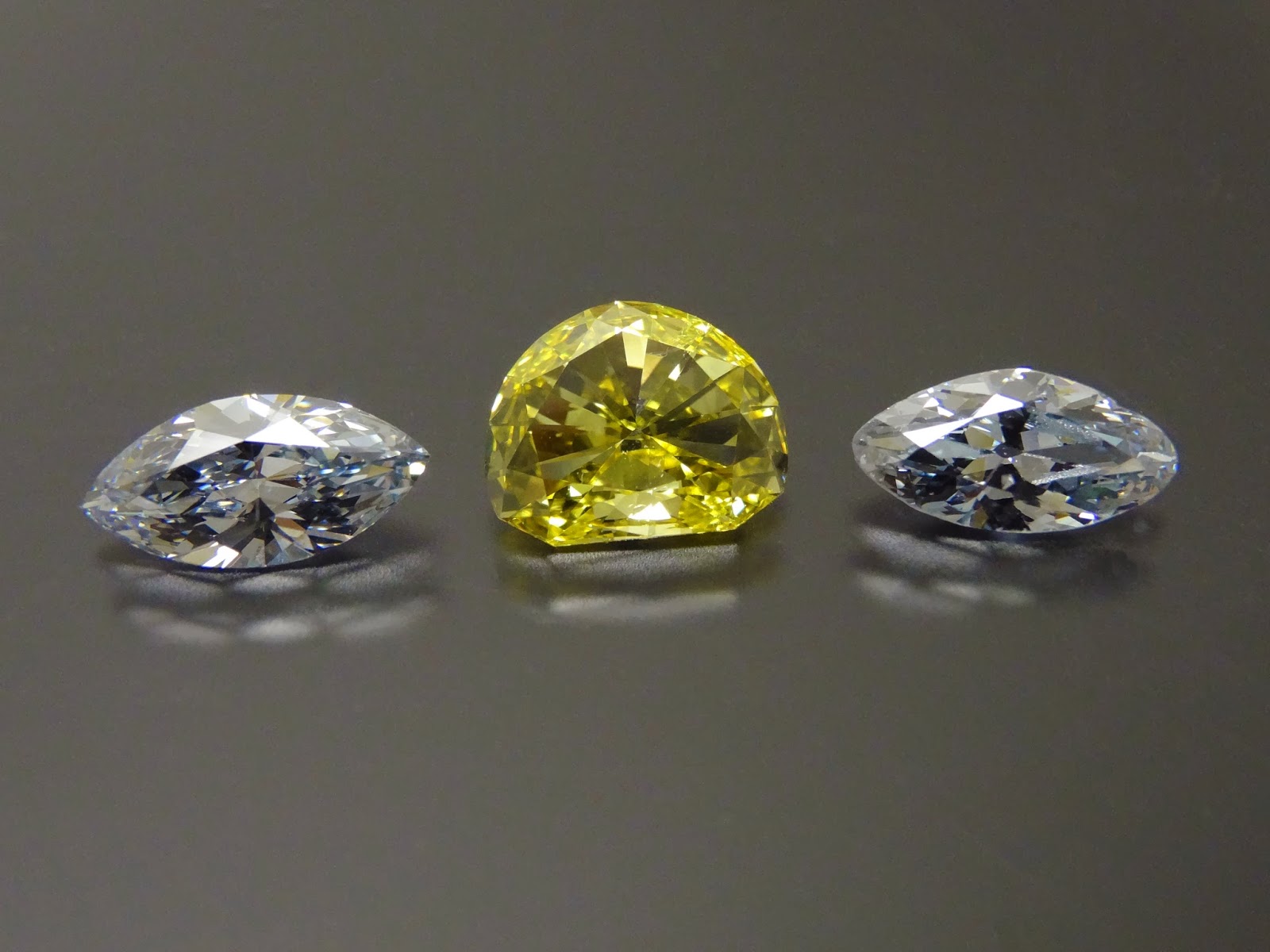
Colorful diamonds from the Butterfly of Peace: green (1.12 ct), pink (0.15 ct) and orangy-yellow (1.31 ct). Photo / Copyright: Eloïse Gaillou.

"You are stealing my heart". 
All extracted from the Butterfly of Peace, of course! Blue diamonds: 0.53 & 0.56 ct; orange: 1.10ct. Photo / Copyright: Eloïse Gaillou.

 By now, you understood that I like the orange heart-shaped diamond! Photo / Copyright: Eloïse Gaillou.

 And I love the white diamonds as well (1.92 ct). Here, associated with this stunning yellow diamond (1.19 ct). Photo / Copyright: Eloïse Gaillou.

Great combination of blue (0.68 & 0.58 ct) and yellow (1.05 ct) diamonds, from the wing of the Butterfly of Peace. Photo / Copyright: Eloïse Gaillou.


FLUORESCENCE


The Aurora Butterfly of Peace, under exposure to UV. A lot of the diamonds fluoresce. Notice that the owner tried to match not only the color, but also the fluorescence on each side of the butterfly's wing. Photo: Robert Weldon. Copyright: Alan Bronstein.

I already explained the cause of color for diamonds in previous blog posts. But I never did for fluorescence. Here is a little blurb on the matter.

It is known that about thirty-seven percent of near-colorless diamonds fluorescence; out of those, ninety-seven percent display a blue fluorescence. The percentage of fluorescing colored diamonds have not been reported yet, but a comprehensive study on fluorescence of colored diamonds can be found in Eaton-Magaña et al. (2007). A blue fluorescence is also commonly seen in some colored diamonds, such as pink, white and Cape yellow diamonds. This blue fluorescence for both colorless and colored diamonds is often due to the N3 center (aggregated of 3 nitrogen atoms around a vacancy), very often associated with the so-called Blue-Band. The Blue Band (also named Band A) is possibly related to the presence of dislocations inside the diamond structure. Yellowish-green emission is fairly common among brown and yellow-green diamonds. It is often due to the H3 center (two atoms of nitrogen around a vacancy) and is created during plastic deformation. Diamonds presenting an orange tint often display yellow fluorescence. Blue type IIb diamonds never display fluorescence, but they sometimes show phosphorescence. In this case, most of them glow a faint blue-green for only a few seconds after exposure to UV light (especially short-wave UV). In rare cases (the Hope and the Wittelsbach-Graff diamonds for example), blue diamonds will show a long-lasting (more than a minute) red glow (refer to this blog post for more information on the Hope's phosphorescence). Even if the exact nature of the blue-green and red phosphorescence is not yet completely understood, recent research suggests the involvement of boron interacting with other defects or impurities (creating an acceptor-donor pair recombination).

Look at this fluorescence! Photo / Copyright: Chris Raum.


Monday, January 21, 2013

Color in Diamonds

Natural colored diamonds part of the National Gem Collection. © Smithsonian Institution. Photo: Chip Clark.

Do you always think of diamonds as being "white" (or, properly speaking, colorless)? Well... if so, think again! In nature, diamonds can be found in all the colors of the rainbow. The ones that are the most prized have an intense tint, referred in the gem market as a "fancy" to "fancy vivid" diamonds. Also, there are tricks to change, enhance or improve the color of a natural (or synthetic) diamond, but I won't get that much into these details on this blog post.


How does a diamond acquire its color?

Most minerals (remember, a gem is just a cut / faceted mineral!) are colored by chemical elements that produce color, for example:
- Copper gives a green, blue or red color,
- Manganese gives a red to orange to yellow color
- Cobalt gives a pink color
- Iron gives a blue, green, red or yellow color.

Diamonds do not contain such coloring agents. Instead, they can contain chemical impurities that don't have an intrinsic color, but their presence inside the carbon structure of a diamond induces some absorptions in visible light, resulting in the diamond coloration. These are called "color centers" or "point defects". Impurities are counted in part per million (one non-carbon atom for every one million of carbon atoms). The most common impurities in natural diamond are nitrogen (N) and hydrogen (H); both can be hundreds (or even thousands) of part per million (ppm). A rare occurrence, but notable in our case, is boron (B) as an impurity.
A perfect diamond structure.

In black: Carbon atoms. In white: Boron atom. Only one boron atom for every other million carbon atoms is enough to produce a blue color in diamonds. Boron is considered  a (rare) impurity.

If you want to know more about the physics of the cause of color in diamond and in minerals in general, one should refer to this article by Kurt Nassau.


Brown: the most common color for diamonds

Brown diamonds are the most widespread colored diamonds. They were used only a few years ago almost exclusively for industrial purposes, now they are invading the market. Brown diamonds became popular a few years after black diamonds appeared on the market 10 years ago. Brown is still not the most desirable color, as it is not a vibrant color. However, a good marketing strategy made brown diamonds more attractive by labeling them as champagne, cognac or chocolate diamonds, from the lightest to the darkest brown color.
The Wilkinson brooch, composed of champagne, cognac and chocolate diamonds... In other words: brown diamonds! © Smithsonian Institution. Photo: Chip Clark.

Most brown diamonds have a zoning of their color, creating a zebra-like structure, alternating brown and colorless areas (see picture below). When the diamond is properly cut, this zoning is not visible, as it occurs in only one or two directions (in the 111 planes). But when the diamond is purposely cut and polished perpendicular to those features (as below), this so-called "graining" can be revealed. Plastic deformation of the diamond while it was still underneath the Earth surface created these deformation lamellae, in which the brown color developed.

A brown diamond plate, in which the graining is visible. © Gaillou.

The residual stress due to the plastic deformation is easily visible between cross-polarizers, a standard technique used by mineralogists and gemologists.
The same brown diamond plate in between cross polarizers. High birefringence follows the direction of the graining, reflecting the stress remaining in the diamond structure.© Gaillou.

Recent studies revealed that the brown color is due to "holes" (vacancies) inside the diamond structure, with groups of missing carbon atoms (about 60 per group). These groups of vacancies were created during the plastic deformation stage of the diamond. These diamonds can be "cured" by a laboratory treatment called "high pressure, high temperature" (HPHT), removing the brown component, either giving a colorless diamond (for type IIa diamonds), or creating a yellow color (for type Ia diamonds, creating the H3 center). Irradiation followed by annealing treatment would also create a yellow color.
A perfect diamond structure (on the left), and a diamond missing a lot of his carbon atoms in one area, which creates locally a brown color. Extracted from Jones (2009).


Black: the king of pavé settings.

De Grisogono diamond jewelry, set with colorless and black diamonds. © De Grisogono.
De Grisogono panther-shaped platinum bracelet dominated by black diamonds. © De Grisogono.
De Grisogono pearl ring, with black and colorless diamonds. © De Grisogono.

Black diamonds emerged in the gem market at the same time the Swiss jeweler De Grisogono opened his company in 1993. Just like brown diamonds, black diamonds were not used in the gem market before then, but directly sent for industrial use. Now, black diamonds are often use in pavé settings (a lot of small diamonds decorating jewelry pieces), as it contrasts perfectly with colorless diamonds. It is only rarely used as a center gemstone (such as below).

The Spirit of De Grisogono, a 312.24-ct black diamond. © De Grisogono. 

The most amazing thing about black diamonds is that they are never really black! Sometimes, it is the presence of numerous black or grey inclusions (graphite, sulfide, etc.) or fractures that makes them look black. With a microscope, one could see that the diamond is colorless or brown... or any other color, just heavily included, so that the light can not (or hardly) go through the stone. Another reason diamonds can be black is the high saturation of the color, such as, typically, a deep brown, red or green color. In this case, when the diamond is looked with a strong fiber optic source behind, the color can be observed.

Nowadays, some diamonds (mostly brown) may be treated in laboratory to blackened them. It can be done, for example, by strong irradiation of the stone.


White: the essence of opalescence.

Commonly, people refer to colorless diamonds (they don't have any color and they are transparent) as "white diamonds" (which really refers to white opaque or semi-opaque diamonds). They are wrong! Look at the pictures below, and you will most likely see the difference between these diamonds and the diamonds you had in mind.
Two small white (or "opalescent") diamonds.

The whiteness is due to the presence of numerous tiny inclusions, just the right size to diffract light, creating this milky, or "opalescent" appearance. If you put a light behind such a diamond, it will appear milky orange. Also, sometimes, the presence of a strong bluish fluorescence can cause the diamond to look opalescent.
The Royal Butterfly brooch from the National Gem Collection. The wings are made of a pair of yellow (bottom wings) and grey slices of diamonds, and a pair of white and grey slices of diamonds (top wings).© Smithsonian Institution. Photo: Kenneth Larsen.


Yellow: the vibrant Canary color

The Bird on a Rock: The 128.54-ct diamond owned by Tiffany & Co. This extraordinary yellow diamond comes from the Kimberley mine in South Africa, and was purchased rough by Charles Tiffany in 1877. © Tiffany & Co.

Only the saturated (fancy) yellow diamonds are valuable. The origin of the color is well known, and in most cases due to the so-called N3 color center, involving a group of 3 nitrogen atoms surrounding a vacancy (see below).
 In black: carbon atoms; in white: nitrogen atoms. The N3 center is the color center inducing the yellow tint in most yellow diamonds.
The 18.24 ct Shepard diamond, in the National Gem Collection. © Smithsonian Institution. Photo: Chip Clark.
The 253.7ct rough Oppenheimer diamond. © Smithsonian Institution. Photo: Chip Clark.
The Lady Zahira, a 2.26-ct Fancy Vivid Yellow diamond heart is embedded in a rose gold encasing.© Sophia Fiori.

As nitrogen is the most common impurity, it is very easy to grow yellow synthetic diamonds. Actually, it is much more difficult to grow a colorless diamond than a yellow diamond, due to the fact that nitrogen is pretty much everywhere in our atmosphere. Also, natural pale-yellow or brown diamonds may be treated (by irradiation, then annealing) to enhance the yellow color.

Green: naturally irradiated.

The  most famous example of a green diamond is the Dresden Green, in display in the New Green Vault in Dresden, Germany. We visited it in August 2012, and I have been transcended by the diamond's beauty. The green color exhibited by the diamond has a steel tint to it that makes it, at least to me, one of the most special diamonds I have seen so far. The pictures below don't really do it justice... It is a must see!
The Dresden Green, the biggest green diamond to date (40.70ct); it is a type IIa diamond. © Pricescope.
Another picture of the Dresden Green in its setting. © Famous Diamonds.

The green color comes from a color center (named GR1, related to vacancies) that is produced by irradiation of the diamond, when it was still in its host rock deep inside the earth. In most cases, rough green diamonds only have a thin outer crust that is covered with green irradiation spots, while the rest of the diamond is colorless, or another body color. Cutting and faceting such a diamond would remove the superficial green color. The irradiation in this case is due to alpha and beta particles.

To get a homogeneous green color, gamma rays or neutrons are required, which have a much greater penetration depth. These processes can also happen in nature, as the Dresden Green diamond illustrates. Most likely, the diamond has been in contact with a U-rich mineral like uraninite in its early life.

As green diamonds are rare, their price can be pretty impressive... For example, this 2.52 ct Fancy Vivid Green was sold at Sotheby’s auction for $3.08 Million in November 2009.© Sotheby.

Irradiation can also be done in a laboratory... and unfortunately, it is hard, and sometimes impossible, to tell if the irradiation is natural or not.


Blue: the "purest" diamond?

The 31.06-ct Wittelsbach-Graff (left) and the 45.52-ct Hope diamond.© Smithsonian Institution. Photo: Chip Clark.The Hope diamond is on permanent display at the Smithsonian Institution, and the Wittelsbach-Graff is now in a private collection.

We will refer the reader to our blog post published about the Hope diamond to get a comprehensive understanding on blue diamonds.
The origin of the blue color is well-known, and is due to the presence of the chemical element boron (B). The boron present in blue diamonds is in extremely low concentration (1ppm or less). Also, for the diamond to be blue, the concentration of other impurities (such as the common nitrogen atoms) has to be less than the one of boron, making those diamonds virtually the purest diamonds of all! These diamonds are referred as type IIb diamonds.
The Hope diamond as we are used to seeing it, in its Cartier setting. © Smithsonian Institution. Photo: Chip Clark.
The 30.62-ct Blue Heart diamond out of its ring setting. It is on permanent display at the Smithsonian Institution. The Blue Heart has the most gorgeous blue color of all blue diamonds I have seen... Yes, I prefer its color to the Hope, but that's only a personal preference! © Smithsonian Institution. Photo: Chip Clark.
Blue diamonds are extremely rare, especially when they don't have a grey component, and their the color is intense. For example, this 7.03-ct Fancy Vivid Blue diamond was sold for $9.48M at a Sotheby's auction in May 2009. © Sotheby.

Sometimes, a less desirable grey component is seen is present in natural diamonds. The grey color might be due to plastic deformation. This grey color may be removed with a high pressure high temperature treatment (HPHT) in a laboratory.
Also, it is possible to grow synthetic diamonds doped with boron. In this case, such diamonds contain much more boron than the natural ones.
Implantation of boron on natural or synthetic diamonds is also possible, producing a blue and boron-rich "coating" of the diamond. So far, I have only seen a few geeky colleagues, (not to cite any names), to own such diamonds!


Pink: when deformation adds attractiveness and value.

This 5-ct Fancy Vivid Pink diamond was sold for $10.8M at a Christie's auction in December 2009. © Christie's.
The same 5-ct pink diamond put into perspective. © Christie's.

Pink, red and violet diamonds are the most expensive diamonds on the market right now. Their color is related to some plastic deformation that happened in the early history of the diamond, when it was still deep inside the Earth. Diamonds can accommodate plastic deformation by re-arranging their atoms, creating twins (the process is called "mechanical twinning"), as shown in the picture below (Gaillou et al., 2008; Gaillou et al., 2012), and also creating an unexplained color center creating the pink hue. Similarly to brown diamonds, the color is not homogeneous but segregated in lamellae or bands.
The color center inducing the pink color is not perfectly constrained, but recent studies showed that it most likely involves a defect composed of nitrogen atoms associated with vacancies (Gaillou et al., 2008;  Byrne et al., 2012Gaillou et al., 2012).
A slice of a pink diamond from Argyle, Australia. The zebra-like structure, with alternating colorless and pink bands, are easily seen on this sample. © Gaillou.
Another case of pink diamond with discrete pink lamellae in a colorless diamond matrix. © Gaillou.


Each pink band or lamella is made of multiple "mechanical twins", such as this one shown here in this transmission electronic microscope image. The arrows point at the twin plane. Each white spots is one carbon atom. © Gaillou et al., 2008.

The range of pink diamonds: scale to grade Argyle (Australia) pink diamonds.© Argyle Pink Diamonds.

The Lady Leilani, a 1.73 Fancy Vivid Pink heart shape diamond is set in a modern rhythmic white gold tear drop pendant with pave white diamond accents. © Sophia Fiori.
The 5.11-ct Moussaieff Red diamond.© Moussaieff Jewellers.


Among all these pink diamonds, a pure red diamond is the rarest of all. The Moussaieff Red (5.11ct) is graded Fancy Red, and is the biggest red diamond known. The Lady Heart Red is smaller (1.71 ct), but has the best grading possible: Fancy Vivid Red.

For the spectroscopists out there who are wondering what's happening with the violet diamonds... Well, it's just a combination of pink and blue! The transmission in the blue is due to the absence or the weak presence of the N3 center.
UV-Visible spectrum of an Argyle violet diamond. © Van Der Bogert et al., 2009.

Note that it is impossible, so far, to grow synthetic diamonds that replicate the natural pink diamonds (with zebra-like pink zoning, due to deformation). However, it is possible to treat some specific (type Ib) synthetic or natural diamonds to create a color center called "NV center", which produces a pink color. But these diamonds are easily distinguishable from the natural ones.


Orange: the rarest of all?

In one of my reference books on diamonds, "The Nature of Diamonds" (by G. Harlow), the orange color has been described  has "probably the rarest color found in diamond" with a "lists of buyers waiting for stones of this exceptional tint". A pure orange (such as the Fancy Vivid Orange heart shape diamond of the Sophia Fiori collection) does not contain any brown component.

The 5.54-ct Fancy Vivid Orange Pumpkin diamond. © Winston.
The Lady Orquidea, a 2.0-ct Fancy Vivid Orange heart shape diamond is mounted in a heart shaped bezel accented with pave white diamonds.© Sophia Fiori.

I would definitely say that pure orange diamonds are the most mysterious of all diamonds, as they have never really been studied... or at least, if so, the studies have never been reported. Only 2 short publications mentioned a description of the Pumpkin diamond, but no spectroscopy results were provided. In the "Nature of Diamonds", Fritsch indicates that the orange color comes from the presence of a broad band centered at 480 nm (in the blue), but its nature has never been explained.


Grading colored diamonds.

I will refer the reader to this website, which has a great explanation about the terminology. I think that this chart from the same website explain it very well. The most desirable grades are Fancy Intense and Fancy Vivid, the latter being the rarest.
The scale and the 9 different grades for colored diamonds. This chart is applicable to the nominally 27 colors. While "Faint" is the closest to a colorless diamond, Fancy Vivid is the rarest and most desirable grade. © Novel Collection.