Showing posts with label gems. Show all posts

Friday, January 3, 2014

European Gem & Mineral Experience: a trip organized by the curatorial staff of NHMLAC

June 27th- July 7th 2014

A splendid mineral and gem journey through France and Germany led by Curator Eloïse Gaillou, Emeritus Curator Tony Kampf and Collections Manager Alyssa Morgan 

• 5 nights in Obernai, France, 2 nights near Idar-Oberstein, and 3 nights in Dresden, Germany

• Sainte-Marie-aux-Mines Mineral & Gem Show

• Private mineral & museum collection tours

• Mine & Wine: Exclusive excursions of famous mines and celebrated vineyards

• Visits with prominent mineral, gem, and carving dealers

• Outings to historical castles and cultural sights

• European culinary delights

Top: Main street in Sainte-Marie-aux-Mines. Bottom, from left to right: Terra Mineralia quartz specimen; Moor bearing emeralds; the city of Dresden. 


Itinerary (subject to change): 

June 27: Arrive at hotel in Obernai, near Strasbourg, France. First dinner with the group.
 
Obernai (copyright: freevisits.com)


June 28:  Attend the wonderful Sainte-Marie-aux-Mines Mineral & Gem show: a guided tour with curator Eloïse Gaillou. Visit of the show special exhibit.
Gem show at Sainte-Marie-aux-Mines (copyright: E. Gaillou)

This wulfenite from the Red Cloud Mine, Arizona was part of the special exhibit on "American Treasures" at the Sainte-Marie-aux-Mines show in 2013. Collection: Musée des Mines ParisTech (copyright: E. Gaillou).


June 29: Free morning at the show. Afternoon: visit the silver Tellure mine and museum near Sainte-Marie.
Mine de Tellure (Copyright: www.tellure.fr)


June 30: Visit a mine in the Vosges Mountains. Wine tasting and visiting a vineyard located in an old fluorite quarry, in the Alsace wine region.
(Copyright: mineralwine.it)


July 1: Visit the Clara mine in the Black Forest, Germany. Visit the showroom and shop of an international mineral dealer near Strasbourg.
Dumps at the Clara Mine (copyright: Luigi Chiappino).


July 2: All day in Idar-Oberstein, Europe’s historic gemstone center. Morning: visit to the historic gem cutting water mill (Weiherschleife) and to the Gemstone Museum (Edelsteinmuseum). Afternoon and private dinner at world-renowned dealer Constantin Wild’s workshop. Tour of his gem-cutting workshop and gem showroom; possibility to “cut your own” gemstone.
The day in Idar will include a tour of Constantin Wild's workshop (copyright: C. Wild).


July 3: Morning at master carver Andreas Becker’s workshop (family business since the 16th century). Afternoon: travel along the beautiful Mosel River Valley, famous for its delicious wines and incredible castles.
 Hummingbirds by Gerhard Becker, carved out of Californian tourmalines (copyright: Bohnams).


July 4: Tour some gorgeous castles near Cochem, Germany before traveling to Dresden in the afternoon.
Along the Mosel River: the Cochel Castle (copyright: H. Peierl).


July 5: Visit to the Old Green Vault (Grünes Gewölbe) in Dresden, housing the extraordinary treasures of the Kings of Saxony. Afternoon free to enjoy the beautiful and historic city of Dresden (optional activities recommended by staff).

The Jewel room at the Green Vault (photo: D. Brandt, copyright: SKD).


July 6: Visit the historic mining town of Freiburg, Germany. Morning: private tour of the renowned mineral collection of the Technische Universität Bergakademie Freiberg by curator Andreas Massanek. Afternoon: visit to Terra Mineralia, a new museum featuring the collection of Dr. Erika Pohl-Ströher, with over 3,500 spectacular mineral specimens on three floors.

The Treasure Chamber at Terra Mineralia (copyright: germany.travel)


July 7: End of tour.

*********
***
*********


10-Day Tour Cost: $4,000 per person 

Includes meals, accommodations, & transportation during the tour (excludes airfare and other expenses before and after the tour) 

• $500 per person deposit required to reserve a spot on the tour
• Full payment due by May 1st 2014
• Registration for Gem & Mineral Council members begins December 7th 2013
• Registration for non-members begins December 14th 2013

Reserve early, space is limited. 

Gem & Mineral Council 
Natural History Museum 900 Exposition Blvd.
Los Angeles, CA 90007 
gmc@nhm.org 
213-763-3326

Wednesday, November 27, 2013

The Aurora Butterfly of Peace: bringing it to the NHMLAC

The Aurora Butterfly of Peace: an art piece composed of 240 natural fancy colored diamonds. Photo: Robert Weldon. Copyright: Alan Bronstein.


COLORED DIAMONDS


By now, I think that most of you know my passion for colored diamonds. Yes, they are pretty and some are extremely expensive. But my interest is mainly in their scientific significance. It is because they contain fortunate imperfections that they have color. These imperfections can tell us more about the environment in which diamonds grow. In particular, I study the pinks and the blues: 

- pink (to purple and red) diamonds have undergone some intense plastic deformation while still in the Earth's mantle (150km or below). To accommodate extreme forces in the deep Earth, diamond might not break, but instead re-arrange its atomic structure, creating slip planes (or even twinning, in the case of pink diamonds). This can only occur under the high pressure and high temperature regime of the Earth's mantle. But what is the exact imperfection that gives the pink color and why is it so rare to find pink diamonds?

- blue diamonds contain boron impurities, which give them their characteristic blue color (such as in the Hope diamond). But what is boron doing so deep inside the Earth? Boron is a volatile element and is mostly found at the surface of the Earth, not really expected to be found 150 km deep or below. How did get there?

These are only a few questions that I'm trying to answer.

Wing shot of the Butterfly of Peace. Photo / Copyright: Eloïse Gaillou.

THE QUEST FOR SAMPLES


During my quest for samples when I was a post doc at the Smithsonian Institution, Mr. Alan Bronstein crossed my path. As you can imagine, it's not easy to find such rare and expensive diamonds (here, I'm talking about over $2M per carat for the best pink and blue diamonds!). Even the Smithsonian does not have THAT many blues or pinks. And hey, sometimes, you can't do all the experiments you want / need on the Hope or on the Blue Heart diamonds... Can you imagine putting a multi-million dollar into the crusher?

Mr. Alan Bronstein, a New York based diamond dealer, owner of the company Aurora Gems came into play when curator Jeffrey Post of the Smithsonian asked him to help us in our scientific investigation, back in 2010. Mr. Bronstein told us that he will try to help us. A few weeks later, he had 70 blue diamonds for us to analyze! Incredible! Thanks to this new set of data, we were able to complete our study, and publish an article on blue diamonds.

Following up on our interests on colored diamonds, Mr. Bronstein suggested that I should get a chance to study one of his collections of fancy colored diamonds. He sent the Aurora Butterfly of Peace to the Smithsonian in August 2011, so I can "play" with the diamonds in the collection. I knew already that I got the position of Associate Curator at the NHMLAC and had a lot of research projects to wrap up both at the Carnegie Institution for Science and at the Smithsonian. But how often would I have the chance to look at 240 fancy colored diamonds?
So, here I was, looking at every single pink and blue diamond in the collection (I had to make a choice of what I needed to study). My advisors Jim Butler and Jeff Post helped me collecting all the data (infrared spectrometry and phosphorescence, mostly).

When I left the Smithsonian, at the end of 2011, I knew that I needed more time to work on the Butterfly. I was still not completely done with the pinks, didn't study the violet to grey from Argyle, and didn't get the chance to have a look at the orange diamonds, which are the least studed of all... and are now "hot" in the market place ($35.5M for a 14.82-ct fancy vivid orange diamond -the largest known-).


BRINGING THE BUTTERFLY OF PEACE TO LA


Still in regular contact with Mr. Bronstein after I left the Smithsonian, we agreed that the Butterfly should come and visit LA, after its stop at the Boston Fine Art Museum. After getting the agreement of the executives of the NHMLAC, and getting all the paperwork, "voilà"! The Butterfly of Peace is in the hands of the Mineral Science team! It will be on exhibit from Dec. 5th 2013 until June 1st 2014. And... I get the chance to look at the diamonds I didn't have the time to look at the last time I had the art piece in my hands.

When we received the Butterfly and I opened the box containing the diamonds, my heart pumped a few stronger, faster beats! Yes, what an art-piece! Honestly, no photo can do it justice. You know how great a single diamond looks like. Now, imagine 240 of them, all of different colors. AND arranged in a butterfly shape. It is just extraordinary!

A moving moment when I received the Butterfly of Peace. Opening it for the first time after 2 years was a great feeling.Photo / Copyright: Eloïse Gaillou.
Alright, here it is. Wow....... now, let's check if all the diamonds are here! Photo / Copyright: Eloïse Gaillou.

Mr. Alan Bronstein and deceased Harry Rodman put the art-piece together, one stone at a time, dedicating it to "the dissemination of peace and harmony among all men, religions and races". When you look at the Butterfly, peace definitely surrounds you. Well, at least it works on me, and I can't ever get tired of staring at it. Alright, I have to admit, it's even better when you get the chance to play with the diamonds!

Talking about playing, here are a few shots I got of some of the diamonds.
"The Stars of the Night". 
Just love this association of colors. The orange heart-shape diamond (1.10 ct) comes from the body of the butterfly, the yellows (1.11 & 1.02 ct) and pinks from the wings. Photo / Copyright: Eloïse Gaillou.

Pink diamonds from the Butterfly of Peace collection. From left to right: 0.66, 0.48 and 0.49 carats. Photo / Copyright: Eloïse Gaillou.

Opalescent diamonds from the Butterfly of Peace collection. From left to right: 1.94, 1.95 and 1.58 carats. Photo / Copyright: Eloïse Gaillou.
 
Compare a 1.62-carat pink (left) with a 1.21-carat bluish-violet diamond, most likely coming from the Argyle mine in Australia. Photo / Copyright: Eloïse Gaillou.

Colorful diamonds from the Butterfly of Peace: green (1.12 ct), pink (0.15 ct) and orangy-yellow (1.31 ct). Photo / Copyright: Eloïse Gaillou.

"You are stealing my heart". 
All extracted from the Butterfly of Peace, of course! Blue diamonds: 0.53 & 0.56 ct; orange: 1.10ct. Photo / Copyright: Eloïse Gaillou.

 By now, you understood that I like the orange heart-shaped diamond! Photo / Copyright: Eloïse Gaillou.

 And I love the white diamonds as well (1.92 ct). Here, associated with this stunning yellow diamond (1.19 ct). Photo / Copyright: Eloïse Gaillou.

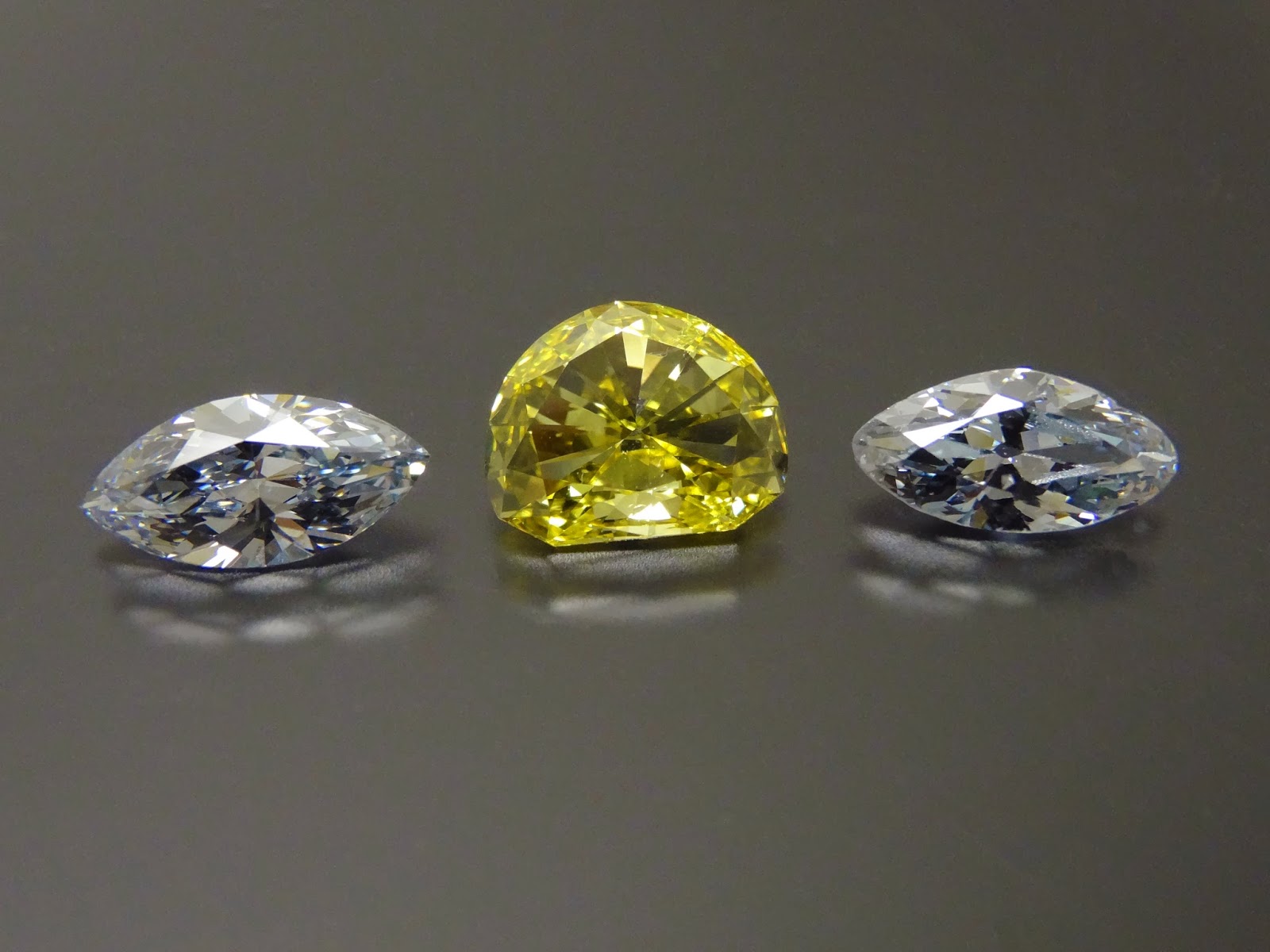
Great combination of blue (0.68 & 0.58 ct) and yellow (1.05 ct) diamonds, from the wing of the Butterfly of Peace. Photo / Copyright: Eloïse Gaillou.


FLUORESCENCE


The Aurora Butterfly of Peace, under exposure to UV. A lot of the diamonds fluoresce. Notice that the owner tried to match not only the color, but also the fluorescence on each side of the butterfly's wing. Photo: Robert Weldon. Copyright: Alan Bronstein.

I already explained the cause of color for diamonds in previous blog posts. But I never did for fluorescence. Here is a little blurb on the matter.

It is known that about thirty-seven percent of near-colorless diamonds fluorescence; out of those, ninety-seven percent display a blue fluorescence. The percentage of fluorescing colored diamonds have not been reported yet, but a comprehensive study on fluorescence of colored diamonds can be found in Eaton-Magaña et al. (2007). A blue fluorescence is also commonly seen in some colored diamonds, such as pink, white and Cape yellow diamonds. This blue fluorescence for both colorless and colored diamonds is often due to the N3 center (aggregated of 3 nitrogen atoms around a vacancy), very often associated with the so-called Blue-Band. The Blue Band (also named Band A) is possibly related to the presence of dislocations inside the diamond structure. Yellowish-green emission is fairly common among brown and yellow-green diamonds. It is often due to the H3 center (two atoms of nitrogen around a vacancy) and is created during plastic deformation. Diamonds presenting an orange tint often display yellow fluorescence. Blue type IIb diamonds never display fluorescence, but they sometimes show phosphorescence. In this case, most of them glow a faint blue-green for only a few seconds after exposure to UV light (especially short-wave UV). In rare cases (the Hope and the Wittelsbach-Graff diamonds for example), blue diamonds will show a long-lasting (more than a minute) red glow (refer to this blog post for more information on the Hope's phosphorescence). Even if the exact nature of the blue-green and red phosphorescence is not yet completely understood, recent research suggests the involvement of boron interacting with other defects or impurities (creating an acceptor-donor pair recombination).

Look at this fluorescence! Photo / Copyright: Chris Raum.